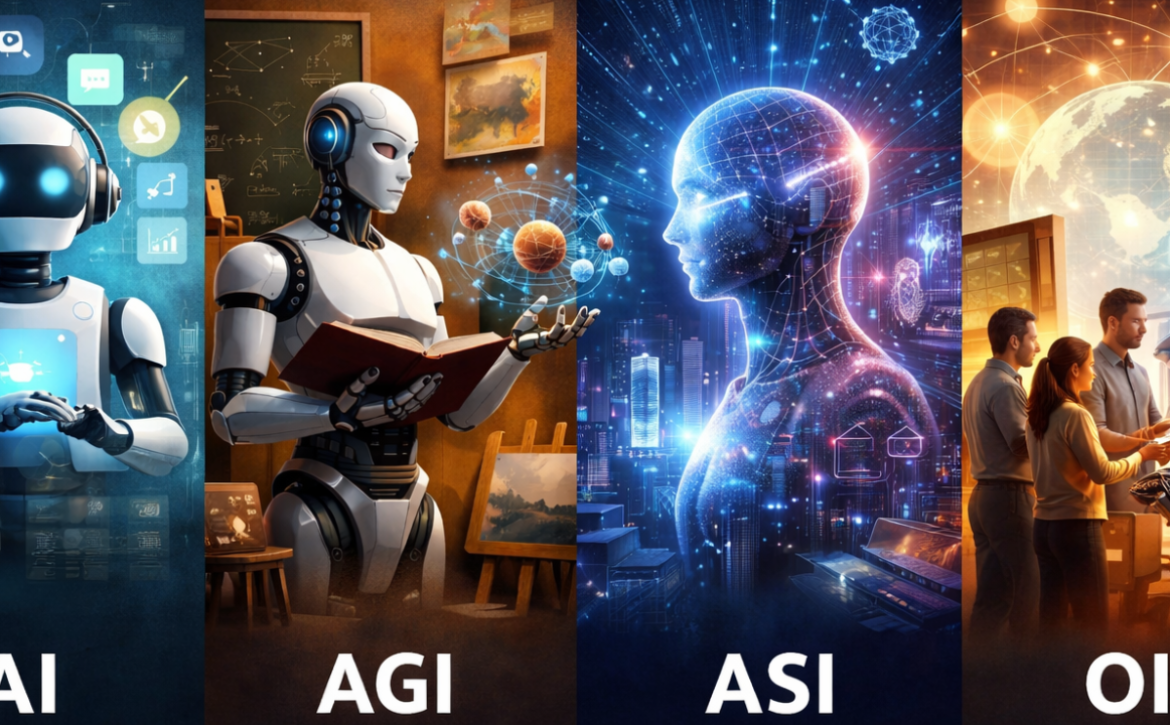
AI vs AGI vs ASI vs OI: Understanding the Future of Intelligence
The rapid growth of artificial intelligence has sparked global curiosity and debate. Terms like AI, AGI, ASI, and OI are often used interchangeably, but they represent very different stages in the evolution of intelligence.
Understanding these concepts is essential for anyone looking to stay ahead in technology, business, or career growth.
What is AI (Artificial Intelligence)?
Artificial Intelligence refers to machines designed to perform specific tasks that typically require human intelligence. These systems are already part of everyday life.
Examples of AI:
- Voice assistants
- Recommendation systems
- Chatbots
- Image recognition tools
Key Characteristics:
- Task-specific (narrow intelligence)
- Data-driven decision making
- Limited ability to generalize beyond training
AI is powerful but constrained. It cannot think or learn beyond its programmed scope.
What is AGI (Artificial General Intelligence)?
Artificial General Intelligence represents a major leap forward. AGI refers to machines that can perform any intellectual task that a human can.
Capabilities of AGI:
- Learn across multiple domains
- Understand context and reasoning
- Adapt to new situations without retraining
Example:
An AGI system could write code, compose music, solve scientific problems, and manage businesses without needing separate models.
Current Status:
AGI has not yet been achieved, but research is progressing rapidly.
What is ASI (Artificial Superintelligence)?
Artificial Superintelligence goes beyond human intelligence in every possible way.
Capabilities of ASI:
- Solve complex global problems instantly
- Innovate beyond human imagination
- Improve itself continuously
Potential Impact:
- Breakthroughs in medicine and science
- Solving climate change
- Risk of loss of human control if not aligned properly
ASI remains theoretical but is widely discussed in future technology scenarios.
What is OI (Organizational Intelligence)?
Organizational Intelligence is a practical and emerging concept. It refers to intelligence created through collaboration between humans and AI systems.
Examples of OI:
- Businesses using AI-driven decision systems
- Teams combining human creativity with machine analysis
- Global collaboration platforms
Why OI Matters:
OI is already transforming industries today. It enhances productivity, improves decision-making, and creates smarter systems than either humans or AI alone.
For businesses looking to implement AI-driven solutions, working with experts can accelerate this transformation. Learn more about professional AI integration services here: maxr.io
Key Differences Between AI, AGI, ASI, and OI
| Type | Intelligence Level | Scope | Status |
|---|---|---|---|
| AI | Narrow | Specific tasks | Widely used |
| AGI | Human-level | General tasks | In development |
| ASI | Superhuman | All domains | Theoretical |
| OI | Collective | System-level | Already emerging |
The Evolution of Intelligence
The progression of intelligence can be understood as:
AI → AGI → ASI
OI runs parallel as a collaborative intelligence layer that enhances all stages.
While AGI and ASI represent future milestones, OI is already shaping how organizations operate today.
Final Thoughts
AI, AGI, ASI, and OI represent different stages and forms of intelligence, each with unique implications. While the world waits for AGI and debates ASI, the real opportunity lies in leveraging AI today and building strong human-AI collaboration systems.
Understanding these concepts is the first step toward staying relevant in a rapidly changing technological landscape.